Archive

Adolf Hitler as an “Architect”: Dictator and Dilettante

Entwurf Hitlers für ein „Führermuseum“ in Linz, Oktober 1938

Adolf Hitler as an “Architect”: Dictator and Dilettante

Hitler's personal involvement in the architecture of National Socialism

Project funded by the Jubiläumsfonds of the Austrian National Bank (No. 18601) · December 2020 – November 2024
Raphael Rosenberg (PI), Ingrid Holzschuh, Winfried Nerdinger, Timo Nüßlein

The project investigates Adolf Hitler's personal involvement in the architecture of National Socialism. His interest for and contribution to buildings exceeds by far examples of other historic rulers. He was on the one hand a builder launching big projects representing his dictatorship, commissioning architects and forcing – e.g. by decrees – their realisation; on the other hand an architect making own designs, giving his architects exact graphic and verbal specifications and often correcting their drafts with his own hand. Hitler's role as a builder has not yet been coherently investigated, his activities as an architect were not yet analysed.

This project contributes to better understanding the NS regime, as for Hitler architecture was an important instrument of representation and exercise of power. It is also important for the comprehension of Middle European architecture of the 1930s/1940s where Hitler's involvement played an essential role.

We compile and analyse Hitler's statements on architecture in general and on specific building projects and approximately 260 architectural sketches by his hand, half of them yet unpublished. We prepare a critical catalogue of those sources and investigate: 1. Hitler's architectural perceptions and their changes from his youth in Linz and Vienna, to the years in Munich up until the end of WWII, as architectural planning remained a privileged leisure activity for the dictator. 2. The cooperation between Hitler and “his” architects, both in the development of the design for buildings and on the administrative level, where Hitler set the architects at the top of new authorities giving them immense power to realise their work within the existing cities. 3. The way Hitler understood and implemented representative architecture as a political instrument for and carrier of NS ideology.

The results of the project are to be published in a book (estimated publication 2025/2026).

Belvedere Before and After

Two participants at the Upper Belvedere, January 2018. Photo: University of Vienna, Department of Art History

Belvedere Before and After

Study · 2018/2019
Raphael Rosenberg, Luise Reitstätter, Hanna Brinkmann and Tiago Santini, with a team of twenty students and assistants (data collection and processing)
Cooperation: University of Tübingen, EVA Lab (University of Vienna), Austrian Gallery Belvedere

In January 2018 the study “Belvedere Before” was conducted by the Lab for Cognitive Research in Art History (CReA) in cooperation with the University of Tübingen, the EVA Lab and the Austrian Gallery Belvedere. The aim of the interdisciplinary team, consisting of art historians, sociologists, psychologists and computer scientists, was firstly to explore the current possibilities of mobile eye tracking for museum research. Secondly, the team took the chance of a major rearrangement of the permanent collection to find out how visitors perceive the prior constellation of artworks through the methods of mobile eye tracking, subjective mapping and questionnaire. In January 2019, the study “Belvedere After” followed in order to compare the two museum presentation contexts.

Video “Belvedere Before”
Radio report, Ö1 “Moment – Leben heute”, 7 February 2019, by Andreas Maurer (MP3)

Exhibitions of Modern European Painting 1905–1915

Wassily Kandinsky, Komposition IV, 1911, oil on canvas, 159.5 × 250.5 cm, Kunstsammlung Nordrhein-Westfalen, Düsseldorf

Exhibitions of Modern European Painting 1905–1915

FWF project · January 2018 – January 2021
Raphael Rosenberg (PI), Christina Bartosch, Nirmalie Muloli, Tanja Jenni

The project aims to study the history of a crucial moment of modern European painting from the perspective of exhibitions or, more precisely, through the corresponding exhibition catalogues: the period from 1905 to 1915, a time of a particularly dense rise of avant-garde movements such as Fauvism (originated 1905 at the Salon d'Automne, Paris), Cubism, Futurism, Rayonism, Orphism, and Suprematism (founded at the 1915 exhibition 0,10 in St. Petersburg). The core of the project is the creation of a database of exhibitions taking place in this period in which living European artists participated, built from the data of the corresponding catalogues – an estimated 600 exhibitions with roughly 180,000 paintings and 2,000–3,000 artists. The database will be as exhaustive as possible and openly accessible on the internet. The quantitative and qualitative analysis of the collected data serves to outline:

1. The geography and networks of modern painting: where (in which cities and institutions), when, and with whom did artists exhibit?

2. The chronology and geography of exhibiting new forms and propagating “isms”: which kinds of paintings were exhibited when and where?

3. The exhibiting strategies of modern painters: how did artists choose the works to present in which exhibitions? Did they pursue specific policies to make themselves publicly known?

The project delivers a new and much broader ground for our knowledge and understanding of the history of European painting in the early 20th century – changing our understanding of Abstract Art and, to some extent, of the general phenomenon of avant-gardes at the beginning of the 20th century.

exhibitions.univie.ac.at

The Cultural Eye / The Gendered Eye

Heat map of the fixations of 50 Austrian (left) and 50 Japanese (right) participants looking at Cranach's Paradise for two minutes each

The Cultural Eye / The Gendered Eye

FWF stand-alone project (P25821) · 2013–2017, 2019–2020
Raphael Rosenberg (PI); team: Hanna Brinkmann, Anna Miscenà, Jozsef Arato, Vanessa Frentzen, Zoya Dare; former team member: Mario Tadzio Thalwitzer
Cooperation: Helmut Leder (EVA Lab, University of Vienna), Kunsthistorisches Museum Wien

Since the late 19th century, art historians like Moritz von Thausing and Heinrich Wölfflin have been discussing group-specific differences in art viewing, especially those based on historical, geographical, later also social and gender commonalities. More recently attempts were made to postulate culturally determined visual modalities (Michael Baxandall's “period eye”). However, all those attempts were only based on the analysis of artifacts and written sources, and hence remained hypothetical.

The project explored group-specific similarities and differences among art viewers experimentally on the level of eye movements by using eye-tracking technology. The central elements were comparative studies of Japanese and Austrian as well as male and female art viewers. Our hypothesis predicted an impact of diverse cultural socialization and gender on art perception. By analyzing cultural and gender differences within contemporary spectators we aimed to identify the levels and factors of possible historical variances of art perception. The project included studies conducted in eye-tracking laboratories as well as in a genuine museum context (Kunsthistorisches Museum Wien).

Over the course of the museum study, a newly developed eye-tracking system was tested, which should have allowed for a calibration-free, unobtrusive method to record the eye movements of museum visitors. Unfortunately, the measurements of this prototype were not as precise as we had expected. This caused some delay in the project. However, the study was one of the first eye tracking experiments conducted at an art museum with real visitors and was an important step towards establishing a methodology for eye movement research in this context.

Right to the Museum?

Illustration: Stefanie Hilgarth

Right to the Museum?

An Austrian Study on Museum Concepts of the Public and Their Perception

Project funded by the Jubiläumsfonds of the Austrian National Bank (No. 18432) · September 2020 – August 2022
Luise Reitstätter (PI), Anna Frasca-Rath, Karolin Galter, Andrea Mayr

Museums today are in a state of rapid change. Their mission is being discussed and a contemporary version for the 21st century is being sought. The project “Right to the Museum?” aimed for a systematic elaboration of museum concepts of the public through a) the analysis of historical museum texts and b) the empirical collection of contemporary museum perceptions.

The project was realized in collaboration with a sample of Austrian museums, ranked according to their date of foundation: MAK – Museum of Applied Arts (*1863), Austrian Museum of Folk Life and Folk Art (*1885), Kunsthistorisches Museum Wien (*1891), Austrian Gallery Belvedere (*1903) and House of Austrian History (*2017). At the core of the archive research were textual museum concepts, from founding statutes to today's mission statements, systematically collected and evaluated through source and content analysis. The field research investigated museum perception from the perspective of citizens via a quantitative preliminary survey, accompanied museum tours and a subsequent qualitative survey with museum diaries and vignette annotations. Following this method combination, the project created a unique scientific source in order to historically classify current museum developments and provide impulses for a reflective museum practice.

rechtaufmuseum.com

Stadt-Land-Kind. An Intergenerational Ethnography on Rural Images of Longing

Photo: Austrian Museum of Folk Life and Folk Art

Stadt-Land-Kind. An Intergenerational Ethnography on Rural Images of Longing

Sparkling Science project, funded by the Austrian Federal Ministry of Education, Science and Research · September 2017 – October 2019
Martina Fineder, Luise Reitstätter, Paul Reiter, Iris Ranzinger, Herbert Justnik, Astrid Hammer, Katharina Zwerger-Peleska, Matthias Beitl, Mark Elias Napadenski
Cooperation: A project of the Academy of Fine Arts Vienna in cooperation with the University of Vienna (CReA Lab), the Austrian Museum of Folk Life and Folk Art, Werkraum Bregenzerwald, VS Rastenfeld, NMS Kals am Großglockner and Werkraum school Bregenzerwald

Departing from the photography collection of the Austrian Museum of Folk Life and Folk Art, the research project “Stadt-Land-Kind” investigates the myth of a better life on the countryside from an intergenerational perspective. Which images do we use to “write” our history of the countryside? And which social constructs and (future) promises are negotiated in these images? Our first objective is to deconstruct conventional notions of authenticity utilized today in images of the countryside by touristic, product, and political branding.

Our second objective is to update memories of rural Austria through a) the critical investigation of historically and culturally constructed motifs of longing, b) the generation of new multiperspectival images, and c) a collective exhibition. This transdisciplinary approach weaves strands of visual and sensory ethnography, research into design and everyday life, and museology into a fruitful constellation. The methods of intergenerational picture talks, research postcards, and photo expeditions were employed in the ethnographic research process. While the sciences benefit from the analysis and updating of visual and material cultures along with the population, the impetus for educational policy resides in the exploration of an open concept of Heimat and the enhancement of visual literacies with school children and their families. In addition to accompanying workshops, the project opened to the public in a final exhibition at the Museum of Folk Life and Folk Art in Vienna.

stadt-land-kind.at

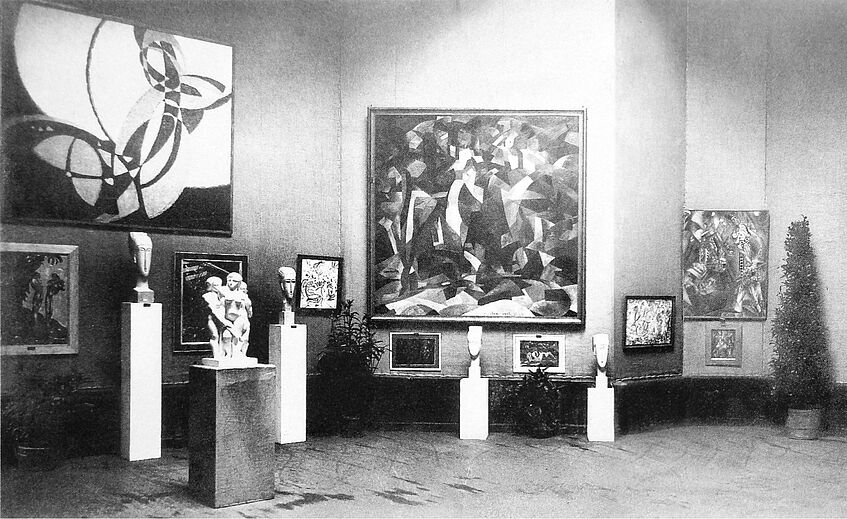
Propagating Abstraction. The Establishment of an Avant-garde, 1908–1915

Exhibition view, Salon d'Automne 1912, Paris, with works by Kupka (left) and Picabia (middle)

Propagating Abstraction. The Establishment of an Avant-garde, 1908–1915

PhD project (FWF-funded, within the research project “Exhibitions of Modern European Painting 1905–1915”)
Christina Bartosch

Around 1912, abstraction was introduced as the new and future mode of expression in the visual arts. The medium for promoting this statement was primarily the art exhibition, as it was for many other artistic movements established in the late 19th and early 20th centuries (e.g. Impressionism, Fauvism, Suprematism). The PhD project focuses on the exhibiting strategies of seven abstract artists working between 1908 and 1915 in order to propagate this “new” mode of artistic expression: Balla, Boccioni, Kandinsky, Kupka, Malevich, Mondrian and Picabia. By means of quantitative analysis, it examines who exhibited what, when and where in order to spot potential patterns that could suggest a strategic behavior in their exhibition participations.

The main research questions are: What did each artist exhibit when and where? What behaviours become apparent? What strategies do those choices reflect? How do they compare to their colleagues'? The project contributes to an open-access database containing information from and about exhibitions that took place worldwide – but mainly in Europe – between 1905 and 1915 and that included modern art.

exhibitions.univie.ac.at

Wild Colors, Gentle Lines?

© René Steyer

Wild Colors, Gentle Lines?

Engaging with color and line in an interactive children's environment

WWTF project · December 2019 – October 2020
Hanna Brinkmann (PI), Rosa Sancarlo, Dorothea Brunialti, Bettina Bernegger, Lea Daro, Christian Ganzer, Luise Reitstätter, Raphael Rosenberg, Andrea Zsutty
Cooperation: ZOOM Kindermuseum, Vienna

What do colors mean to me? Can I also taste, hear, smell and feel colors? What can different lines tell us? Drawing, painting and experimenting with lines and colors tend to be common activities of most children's lives. But also, lines and colors are the very basic elements of painting, especially abstract art. Artists like Wassily Kandinsky were fascinated by lines and colors and the effect they have on the viewers. Kandinsky himself created a questionnaire at the Bauhaus in 1923 to test if basic shapes (triangle, circle, square) are attributed to the colors yellow, blue and red.

Building on three years of theoretical and empirical research on the universality of the effects of lines and colors in the context of art (see “Universal Aesthetics of Lines and Colors?”), the project built a bridge between the academic world and a broad audience, focussing on a specific group: children and their families. We transferred our acquired knowledge in a selected and explanatory manner, enriched with a strong playful aspect, to create thought-provoking impulses and encourage enthusiasm for arts and science.

Our cooperation partner for this transfer project, the ZOOM Kindermuseum, is the perfect environment for informal and social learning. Knowledge was passed on in a number of playful and interactive ways: 1. verbal and visual communication within the framework of an installation in the museum's entrance area; 2. participation through rating and coloring stations; and 3. active engagement in themed workshops through a deeper exploration of the topic as well as animation workshops in a digital format. With the ZOOM being located in the MuseumsQuartier, the project reached a diverse, heterogeneous and intergenerational audience – research gets graspable, real and related to the everyday life of different communities.

linesandcolors.univie.ac.at
Press: “Wie Kinder Linien und Farben wahrnehmen” (uni:view, 27 July 2020)

Towards an Experimental Narratology of the Image

Unedited reconstruction of temporal order in William Hogarth's The Bagnio by a sample participant

Towards an Experimental Narratology of the Image

Lise Meitner project (FWF)
Klaus Speidel

In 1766 G. E. Lessing drew a strict distinction between the arts of time and the arts of space. He explained that only the former (poetry, theater, etc.) should be used for conveying stories, simultaneously asserting that paintings that only show one moment in time are not suitable for narrative. To this day, his point of view is regularly echoed by image theorists as well as researchers specializing in the study of narrative, most of whom maintain that monochronic pictures can only remind viewers of stories they already know. This project challenged these ideas.

The project developed new concepts to deal with pictorial narrative and questioned experts' assumptions based on experiments with more than 220 non-expert viewers. One finding was that viewers largely agreed that certain monochronic pictures tell stories; the difference with pictures of lower narrativity was statistically significant. As storytelling is a concept that non-experts master well, this result calls into question the conviction that monochronic pictures, which only show one moment in time, cannot tell stories. Further analyses focused on how strongly content summaries of different participants resembled each other and whether different viewers reconstructed the same timelines. Results showed that participant scripts summing up the content of a picture did not vary greatly: they all mentioned events that are explicitly or implicitly represented, mostly through traces. To account for this, the concept of “trace-based narrative” was introduced. It was also shown that different viewers reconstructed the temporal order of events implicated in different pictures in very similar ways.

experimentalnarratology.com

Universal Aesthetics of Lines and Colors?

William E. Simmat (ed.), Exakte Ästhetik 6: Objektive Kunstkritik, Stuttgart 1969, cover. Photo: University of Vienna, Department of Art History

Universal Aesthetics of Lines and Colors?

Effects of culture, expertise, and habituation

WWTF project · July 2016 – June 2019
Raphael Rosenberg (PI), Helmut Leder (Co-PI), Jane Boddy, Hanna Brinkmann, Beatrice Immelmann, Eva Specker, Maximilian Douda, Stephanie Sailer, Hamida Sivac

Lines and colors are the basic formal elements of painting. Whether an artwork is perceived as being serene, dynamic, sad or cheerful is heavily determined by the interplay of these artistic media. Yet, how are such perceptions actually generated in spectators and why do spectators like particular pictures, but dislike others? Artists, art historians and psychologists have grappled with these questions for centuries, but their findings had to remain complementary. There is, however, general agreement among artists (such as Kandinsky and Mondrian) and psychologists that lines and colors generate definite perceptions in spectators.

In an interdisciplinary cooperation between art history and cognitive psychology, the project examined the assumption that the perception of lines and colors is basic to the aesthetic effects and liking of painting. We tested this assumption by looking at the impact of single lines and single colors on a perceptual and aesthetic level, extending to more complex interactions between elements, up to actual artworks. By examining the role of art-specific expertise and cultural background (including a comparative study of Austrian and Japanese spectators), we questioned the assumption of a universal perception of lines and colors. The final goal was to gain critical insight into the aesthetic perception of lines and colors and take a decisive step towards an interdisciplinary cognitive science of art.

linesandcolors.univie.ac.at

Time Makes the Difference! Uncovering the Nature of Aesthetic Experience

Time Makes the Difference! Uncovering the Nature of Aesthetic Experience

WWTF project · March 2012 – March 2015
Helmut Leder (PI), Raphael Rosenberg (Co-PI)

The project investigated whether prolonged viewing duration distinguishes aesthetic from ordinary visual perception, hypothesizing that the extension in time – as an elongated perceptual experience with a pleasurable duration – is a constitutive indicator for the difference between the aesthetic experience and the common visual experience. While artworks sustain interest across repeated viewings, ordinary stimuli typically produce habituation and boredom over time. In an interdisciplinary cooperation between cognitive science and art history, the project identified subjective and psychophysical dimensions affecting aesthetic engagement, with applications for museum curation and pedagogy.

timeandart.univie.ac.at

Picture Practices

Picture Practices

Transdisciplinary Studies on Materiality and Habituality of Visual Conventions

Research project
Hanna Brinkmann, Rosa John, Maria Schreiber

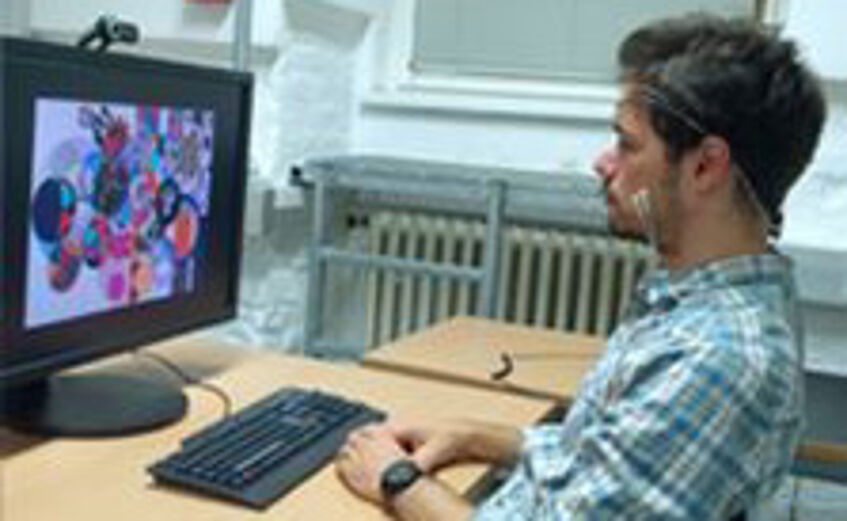
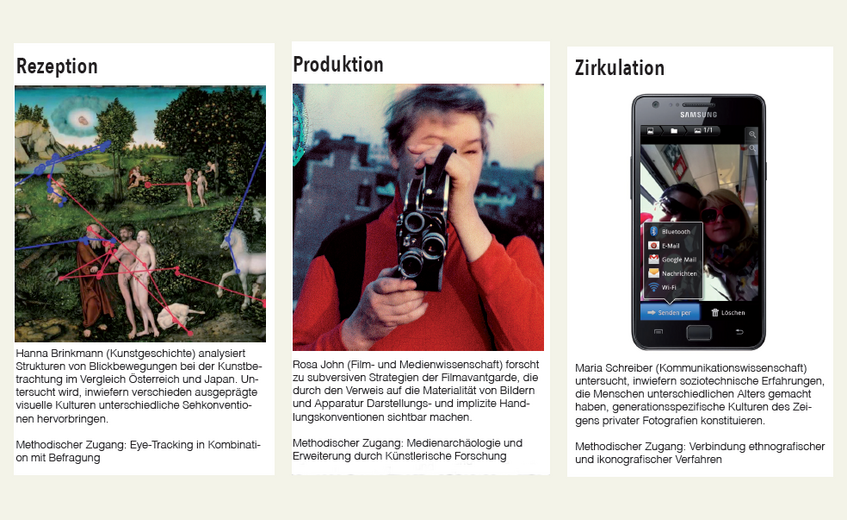
From the perspectives of three disciplines, the project aims to understand how pictures and practices are related in specific contexts: Hanna Brinkmann (Art History) analyses how different ways of perceiving art evolve from Austrian and Japanese visual cultures. Rosa John (Film and Media Studies) focuses on the question how avant-garde filmmakers make visual conventions visible by exploring their material. Maria Schreiber (Communication Studies) investigates how sociotechnical experiences constitute habitual ways of showing in personal photography. All subprojects contribute to the common goal of gaining a deeper theoretical and methodological understanding of the complex entanglement of pictures and practices by combining concepts from picture theory and praxeological approaches.

Stadt-Land-Bild. A Social Image Analysis of Contemporary Conceptions of Longing

Photo montage: dform, 2018

Stadt-Land-Bild. A Social Image Analysis of Contemporary Conceptions of Longing

Top Citizen Science project, funded by the Austrian Federal Ministry of Education, Science and Research · November 2018 – October 2019
Martina Fineder, Laura Commare, Luise Reitstätter, Astrid Hammer, Claudia Peschel-Wacha, Andreas Pawlik, Julian Roedelius
Cooperation: A project of the Academy of Fine Arts Vienna in cooperation with the University of Vienna (CReA Lab), the Austrian Museum of Folk Life and Folk Art, the Ludwig-Maximilian University of Munich (Department of Art History), dform and Visuelles e.U.

In times of digital revolution, worldwide crises and global insecurity there is a simultaneous tendency to look back. This phenomenon – called “Retrotopia” by sociologist Zygmunt Bauman – is accompanied by a longing for authenticity, simplicity and security. It depends on a glorification of conservative values of family, work and community, and is accompanied by a renewed nostalgia for life in the countryside.

Stadt-Land-Bild explored this phenomenon and expanded the visual and material analysis of the base project Stadt-Land-Kind by establishing the exhibition space of the Austrian Museum of Folk Life and Folk Art as a Citizen Science research setting. This included a multi-media research station inviting citizen scientists to actively engage with the image corpus of Stadt-Land-Bild. Apart from autonomous explorations, the program built on intergenerational picture talks as well as guided workshops and open research sessions at peak museum times. Citizen scientists could play the social image tagging game ARTigo and work with the social image analysis tools offered by the ARTigo Analytics Center – both describing images and analyzing the descriptions given by themselves and others. Museum visitors with different perceptions, opinions and experiences, and from different generations, collaboratively reflected upon urban-rural sentimental and ideological constructions of longing so as to make a contribution to an open conception of Heimat.

stadt-land-kind.at/?p=58

“More than the Sum of Its Parts”. Opportunities and Challenges of Empirical Approaches to the Art Sciences

Visualization: Laura Commare

“More than the Sum of Its Parts”. Opportunities and Challenges of Empirical Approaches to the Art Sciences

PhD project (partly funded by the WWTF project “Time Makes the Difference!”)
Laura Commare

Over the last decade we have been observing a new trend in the humanities and art sciences towards the systematic use of empirical methods. Yet, empirical approaches to art research are not without critique. Empirical studies are often faced with skepticism and seen as outside-subject interference from the natural and social sciences. The ability of empirical research to adequately address holistic concepts is doubted, with the consequence that empirical approaches to questions of art are frequently granted no sense of purpose.

The aim of this thesis is to draft a reasoned response to the question on the value of empirical art research and the conditions under which it should be pursued. To this end, it discusses strengths as well as challenges that may be attributed to empirical approaches and investigates their practical relevance by reverting to three specific case studies pertaining to the field of (empirical) reception research. The discussion follows two focal points: a content discussion of the results obtained by empirical means, and a methodical discussion which critically examines the respective approaches of the selected case studies.

The Idea of a Universal Spectator: Abstraction in the Work of August Endell, Wassily Kandinsky and Ferdinand Avenarius

August Endell, ornament, from Dekorative Kunst, 1897. Photo: University of Vienna, Department of Art History

The Idea of a Universal Spectator: Abstraction in the Work of August Endell, Wassily Kandinsky and Ferdinand Avenarius

PhD project
Jane Boddy

The dissertation shows that abstraction in the work of August Endell, Wassily Kandinsky and Ferdinand Avenarius involved notions of a potentially universal spectator, an idea that has not been sufficiently considered in the discussion of their work and the history of abstract art. The dominant view in art history has been that abstraction signifies artistic practices in which artists step away from the imitation of nature and the depiction of material objects and instead reduce lines, colors and shapes to pure form. As a result, abstraction is typically examined as a formal visual trait of artworks.

By contrast, this project examines abstraction as a concept of spectatorship, and argues that the kind of abstraction to be found in the work of Endell, Kandinsky and Avenarius targets the construction of what could be called a “shared space” of psychological connections between people. This is closely linked to artists' and critics' understanding of the expanding field of perceptual psychology and involves their ideological projects, consisting in attempts to forge unity between spectators – ultimately, an antidote to an isolating modernity. To argue this, writings from Endell, Kandinsky and Avenarius about universal languages of forms and feelings are examined, describing how various meanings of abstraction were reconciled in a concept of spectatorship.

How to Lead One's Gaze. The Effect of Auditive Information on Individual Art Perception

Areas of interest on Peter Paul Rubens' The Four Continents © Claudia Pitnik

How to Lead One's Gaze. The Effect of Auditive Information on Individual Art Perception

Master's thesis project
Claudia Pitnik

Comparatively old media like audio guides are still in use in the mediation work of art museums, despite the influences that the technical advancement of the age of social media has on these institutions. The approach taken to develop new tools like museum apps and multi-media guides is not very different from designing audio guides. The clear advantage of this device, which can be used flexibly and easily, lies in using it simultaneously to looking at a painting. But does aural information change the way people look at a piece of art?

Based on previous audio guide research and the results of studies from the psycholinguistic field of the Visual World Paradigm, the question of how such image-describing aural information impacts art perception was investigated through an eye tracking study in the Lab for Cognitive Research in Art History in Vienna. The results show that the gaze of visitors can be guided by aural information if the content arouses interest and offers a surplus value for the viewers. This finding is of great relevance, especially for art education, as it allows conclusions about the form in which aural information should be designed for audio guides or apps in order to achieve a positive effect with as many visitors as possible.